
EU Drivers Hours Guide

Drivers’ Hours Guide: Understanding the Basics
Looking for a brief but comprehensive guide on Drivers’ Hours rules?
There are plenty of free resources online, including the government’s GV262 guidance. However, here at Traxion, we’ve spent years helping drivers understand the rules, so we’ve created this Drivers’ Hours Guide to explain them in a format similar to what we use on our Driver CPC courses. This guide only covers the key principles. We will be publishing future articles that will go deeper into specific rules.
During training, I firstly like to encourage drivers to look at the rules from a positive perspective. Many drivers still hold the “old school” belief that these rules restrict earning potential. In truth, the EU Drivers’ Hours rules allow a lot of flexibility. The regulations exist to protect you from companies that might otherwise push unsafe working hours. Try to view these rules as being for the driver’s protection rather than restriction, and they make much more sense.
We’ll split the rules into two main sections: driving limits and rest periods.
Drivers’ Hours Guide: Driving Limits
Let’s begin with driving limits. The EU rules control how long you can drive in one go, each day, each week, and each fortnight.
You can drive for a maximum of 4.5 hours before taking a break. Driving is only when the vehicle’s wheels are moving. Time spent parked or doing other work doesn’t count, so some drivers might never reach this limit in a shift. A qualifying break must last at least 45 minutes.
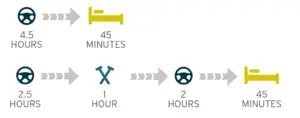
While taking that break, you cannot do any other work. A break is time used solely for recuperation. Sadly, some companies still expect drivers to keep working during breaks. You should consider what that might mean for your liability if an accident were to occur during that time!
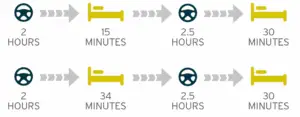
You can split the 45-minute break into two shorter ones: the first must be at least 15 minutes, and the second at least 30. You can, of course, take a break earlier than 4.5 hours; in fact, the minimum drive time before you take a break is just one minute. Once you complete a qualifying break, you can then drive another 4.5 hours.
Daily Driving Limits
The daily driving limit is 9 hours. This total covers all driving between your legally required rest periods.
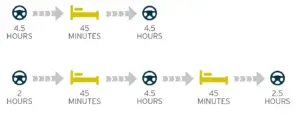
On two shifts in each fixed week, you can extend this 9-hour limit up to a maximum of 10 hours, but any shift where you drive for more than 9 hours will be counted as an extension.
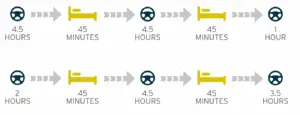
Drivers who work irregular days should pay close attention to the term “fixed week”.
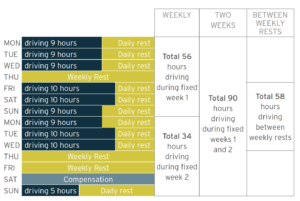
A fixed week starts at 00.00 on Monday and ends at 24.00 on the following Sunday.
That means your two extensions reset at midnight every Sunday. For example, if you work over a weekend, you could extend on Saturday and Sunday, then again on Monday and Tuesday once the new week starts. The EU Drivers’ Hours rules always measure driving limits over the fixed week, no matter what days you work.
Weekly Limits
The maximum weekly driving is 56 hours.
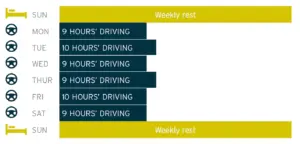
However, across any two consecutive weeks, you cannot exceed 90 hours. In practice, this means you must average no more than 45 hours of driving per week. Remember, these totals are always calculated based on fixed weeks, not rolling days. Our Drivers Hours Guide emphasises this point because it’s the key principle that you need to understand to make sense of the driving limits.
EU Drivers’ Hours Guide to Rest Requirements
The rules also require drivers to have periods of enforced rest each day and each week. It’s important to understand that a “rest” is a period where you cannot carry out any type of work under obligation to someone else, so you cannot work in any industry during a legally required rest period. This is particularly important if driving is only part of what you do. Even if you only drive one day a week, you still need to adhere to the rest requirements for the whole of that fixed week. For example, working in another job from Monday-Friday, then driving every weekend would be completely illegal and would likely result in serious sanctions if caught.
Drivers’ Hours Guide: Daily Rest Requirements
You must take your daily rest within 24 hours of starting work. That gives you a 24-hour window to complete your shift and rest. Rest taken outside that window doesn’t count toward that day. To get a full daily rest, you need at least 11 hours of rest within 24 hours of starting work. That means your total shift must be under 13 hours.
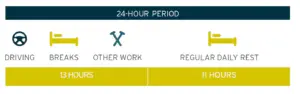
If your shift runs longer than 13 hours, or if your rest drops below 11 hours, then your daily rest is reduced. Reduced daily rest can go as low as 9 hours, but it still has to fit inside that 24-hour window. That makes 15 hours the absolute maximum length of a single-manned shift.
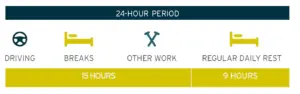
You can only reduce your daily rest three times between weekly rests. That’s different from the driving extensions, which are limited to twice per fixed week. Daily rest reductions reset after your weekly rest, not at the start of a new week. Again, this is a critical point for drivers who work on irregular days of the week.
You can also split a regular daily rest into two shorter rests — at least 3 hours for the first part and 9 hours for the second. This split still counts as a full rest, not a reduction. Just make sure both rests and your shift all fit within the same 24-hour period.
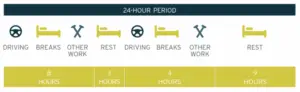
There are some additional relaxations to these rules for vehicles that are multi-manned, and journeys involving ferry or trains, but we want to keep this Drivers’ Hours guide as simple as we can, so we will cover those in separate articles.
Drivers’ Hours Guide: Weekly Rest
You must take a weekly rest after no more than six 24-hour periods since you last started work. In other words, after 144 hours of starting work, you must begin a weekly rest.
A regular weekly rest lasts at least 45 hours.

You can take a reduced weekly rest as short as 24 hours, but you must pay back the missing hours later. That compensation must be paid back “en bloc” — all at once — and attached to a later rest period of at least 9 hours, within the next three weeks.

To make life easier, we would usually recommend paying back any reduction at your next weekly rest instead of delaying up to three weeks. Small reductions can also be repaid by adding a few hours to a daily rest.
There are also restrictions on how frequently you can reduce, as each fixed fortnight must include at least one full 45-hour weekly rest. It’s possible to take two reduced rests in a row, as long as the fixed fortnight still contains one full and one reduced rest.

There are some additional complexities to the weekly rest rules, particularly for international journeys, but we will cover those in separate articles.
Final Thoughts
That’s the foundation of the EU Drivers’ Hours rules. For most drivers, this Drivers’ Hours Guide covers all you’ll need to stay legal and safe. We will be publishing more articles expanding on this and other subjects covered in our training courses.
We hope this guide helps!
Join us for our Drivers’ Hours & Tachographs CPC course for a more detailed explanation of the rules.